
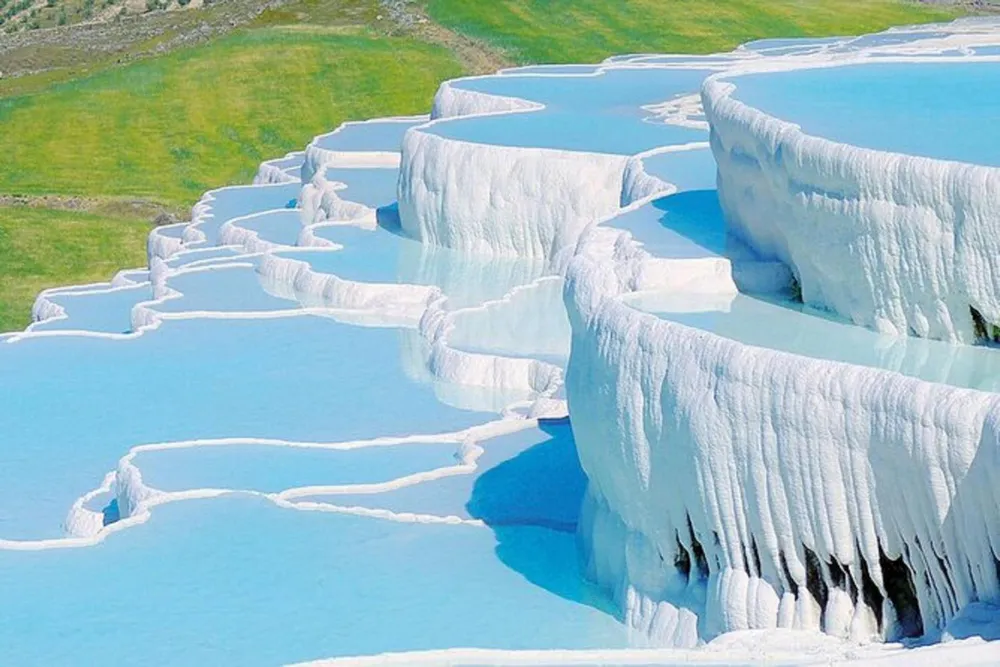
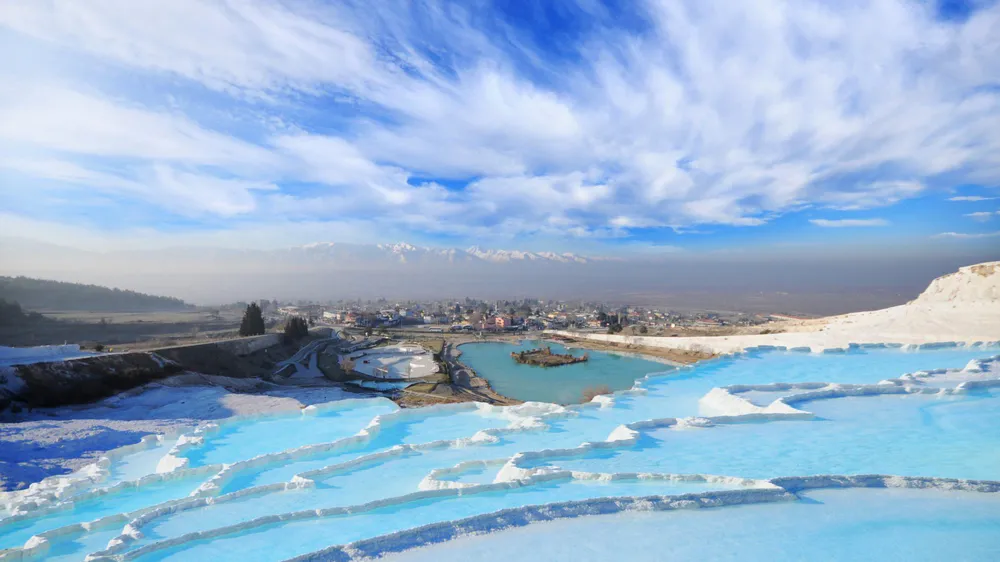
Pamukkale is one of the most photographed places on earth — and it is just 3 hours from Kusadasi. Dazzling white travertine terraces that look like frozen cotton waterfalls, healing thermal waters and the magnificent ruins of the ancient city of Hierapolis — all of this in one full day of experiences that stay with you for a lifetime.
UNESCO World Heritage Site. Private format. English-speaking guide. Daily departures from Kusadasi and Bodrum.
Why Pamukkale Belongs on Every Turkey Itinerary
Pamukkale means “Cotton Castle” in Turkish — and the moment you see those blindingly white terraces for the first time, you will understand exactly why. Over thousands of years, calcium-rich thermal waters have cascaded down the hillside, depositing minerals and forming natural terraced pools — a geological phenomenon found nowhere else on earth at this scale.
But Pamukkale is far more than a natural wonder. Crowning the top of the terraces stands ancient Hierapolis — a Greco-Roman spa city founded in the 2nd century BC, where kings, philosophers and Roman patricians came for centuries to heal and rest. Together, nature and history create something here that is truly unlike anywhere else in the world.
In 1988, Pamukkale and Hierapolis were jointly inscribed on the UNESCO World Heritage List — recognition of their extraordinary combination of natural beauty and historical significance.
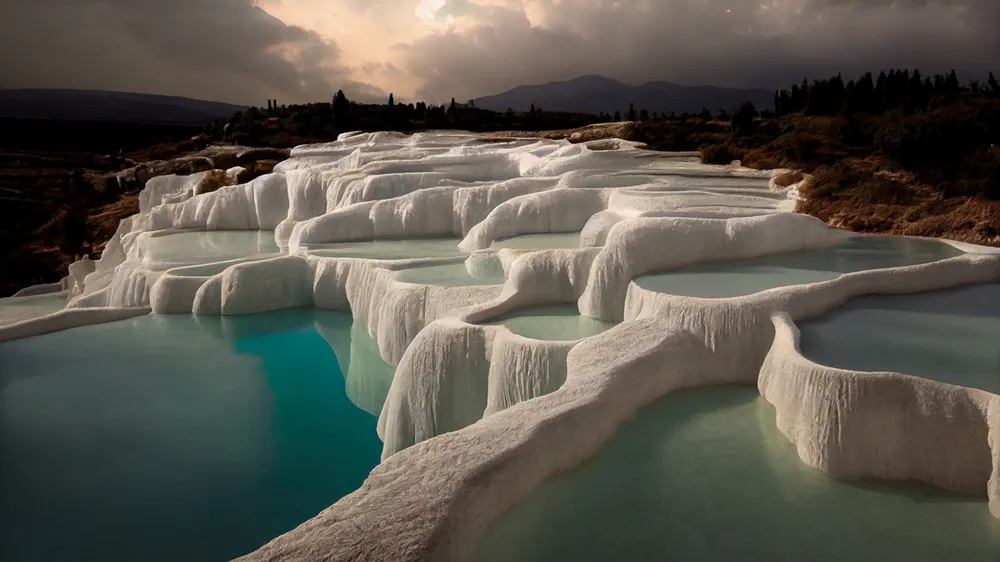
🤍 The Travertine Terraces — Walking Barefoot Through a Natural Wonder
You will walk barefoot (shoes are removed at the entrance) across the snow-white mineral terraces filled with warm, faintly blue water. The water temperature in the pools stays at around 35°C year-round. Your guide will explain how these natural basins formed over millennia, why the water is considered therapeutic, and what minerals give the terraces their famous white colour.
Guide’s tip: the best light for photography is in the morning, before the terraces fill with visitors. We plan the route exactly this way.
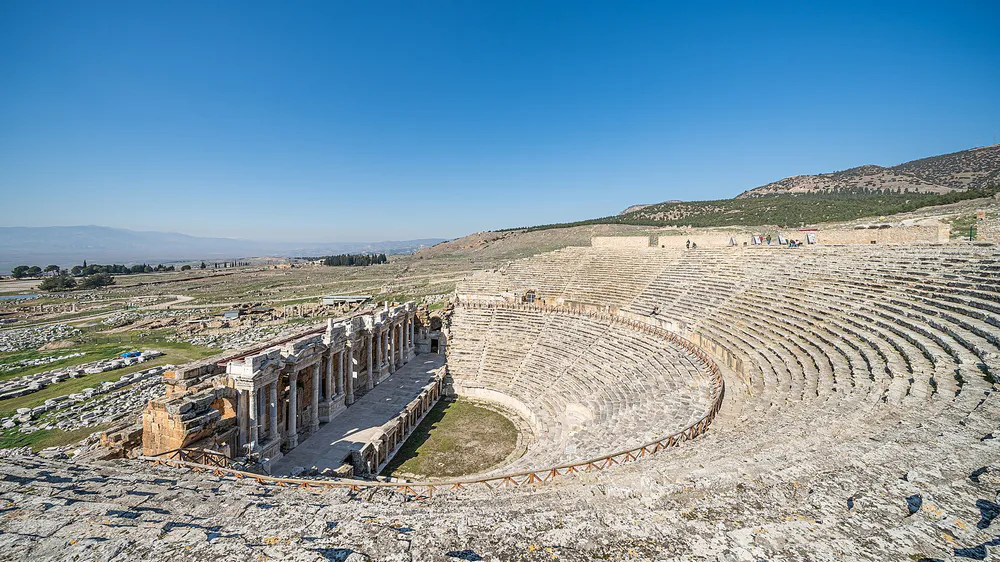
🏛 Ancient Hierapolis — A Resort City 2,000 Years in the Making
Perched on the hilltop above the terraces, Hierapolis is one of the best-preserved ancient cities in Turkey. Founded around 190 BC by the Pergamene king Eumenes II, it remained one of the premier spa destinations of Asia Minor for centuries — drawing visitors from across the Roman Empire seeking cures for their ailments.
Key highlights of Hierapolis include:
The Colonnaded Main Street — the ancient equivalent of a pedestrian boulevard, once flanked by hundreds of columns
The Theatre — seating around 15,000 spectators and in exceptional condition; from the stage, a sweeping panoramic view opens across the valley and down to the white terraces below
The Necropolis — one of the largest ancient burial grounds in Turkey, with more than 1,200 tombs spanning multiple eras; the variety and scale of the funerary monuments is genuinely striking
The Ancient Thermal Baths — monumental ruins of a 2nd–3rd century AD bathing complex, part of which now houses the Hierapolis Archaeological Museum
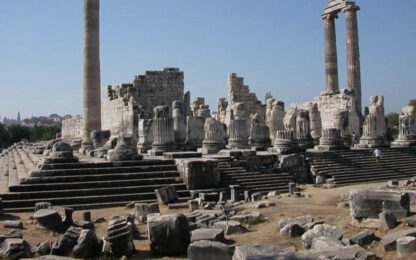
The Temple of Apollo — the city’s main sanctuary, built directly above the source of the thermal waters
The Plutonium — one of the most mysterious sites in all of Turkey: a sacred cave from which carbon dioxide escapes at concentrations lethal to animals. Ancient priests used this phenomenon as proof of their power over life and death. The cave entrance is now sealed, but your guide will tell the full story of this eerie place
The Gate of Domitian and the Arch of Hadrian — monumental entrance gateways marking the ceremonial approach to the city
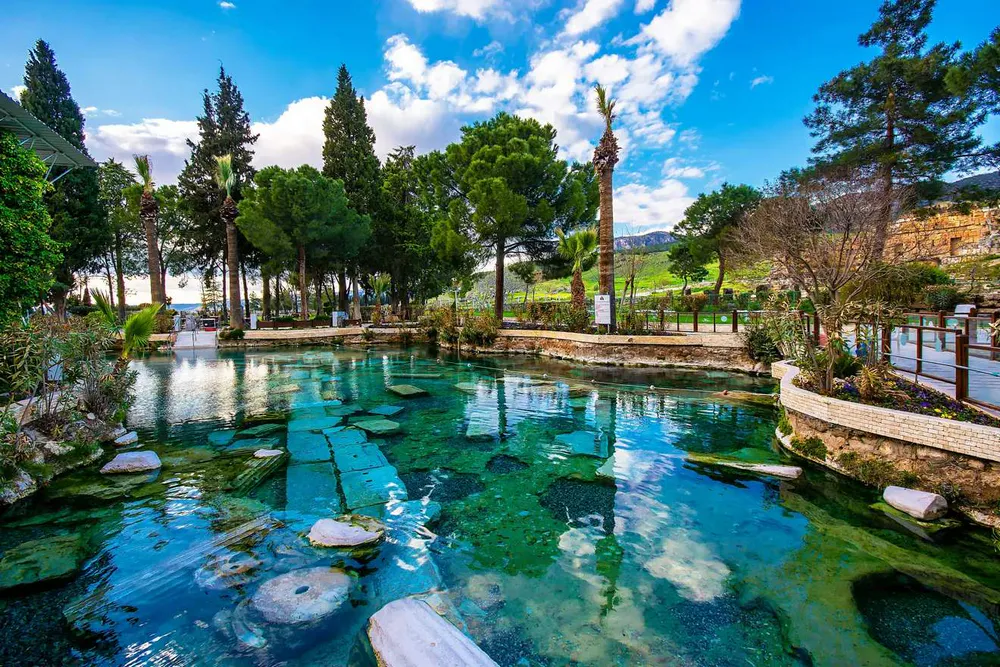
🏊 Cleopatra’s Pool — Swimming Among Ancient Columns
Legend holds that Cleopatra herself bathed in these thermal waters to preserve her beauty. What is historically certain is this: the pool is fed by the same mineral-rich spring that creates the travertines, and lying on its floor are genuine marble columns and architectural fragments — casualties of an ancient earthquake that toppled part of the city.
The water temperature holds at around 36°C. Entry requires a separate ticket — but the experience of swimming among actual ancient Roman columns in warm mineral water is unlike anything else you can do in Turkey. Pack your swimsuit.
🏺 The Hierapolis Archaeological Museum
Located on-site within the former ancient baths, the museum houses finds from Hierapolis and the surrounding region: sarcophagi, sculptures, coins, jewellery and everyday objects. Your guide will provide context that transforms artefacts from curiosities into windows into daily life two thousand years ago.
📸 Panoramic Views and the Best Photography Spots
From the hilltop of Hierapolis, the view across the Çürüksu Valley is breathtaking — white terraces cascading down the hillside against a backdrop of green fields and distant mountains. This is one of the most iconic landscapes in Turkey, and your guide knows exactly where to stand and when for the best shots.
How the Tour Works
The excursion runs as a private tour — just you and your group, with no strangers and no group-tour rushing. The itinerary is tailored to your interests and pace: if you are travelling with children or older participants, we adapt accordingly.
On the road to and from Pamukkale, guide Farida shares stories about the history of the region, Turkish culture and local life — guests consistently note in their reviews that the journey itself is as engaging as the destination.
Duration: Full day (approximately 10–12 hours including travel) Distance from Kusadasi: approximately 190 km (≈ 2.5–3 hours each way) Language: English or Russian Format: By car + on foot Availability: Daily
Transfer & Logistics
- From Kusadasi or Bodrum — departure in a comfortable private vehicle with your guide
- From other cities — transfer arranged on request, or we meet you on-site
- Pick-up: from your hotel or an agreed meeting point
⚠️ Please note: entrance tickets to Pamukkale/Hierapolis and Cleopatra’s Pool are paid separately on-site. Ticket prices are updated periodically — please confirm current prices at the time of booking.
What to Bring
A swimsuit and towel (for Cleopatra’s Pool and the travertine terraces), easy-to-remove footwear (the terraces are explored barefoot), sunscreen and a hat, water and a light snack. Lunch can be arranged at a local family restaurant near the site — your guide will recommend tried and trusted options.
What Our Guests Say
“We walked the white travertines, swam in Cleopatra’s Pool, learned myths and traditions — Farida revealed the full history of this place in a way we had never experienced before.” — Larisa
“We explored ancient Hierapolis, visited the museum, and had a wonderful lunch at a local family restaurant. A day we will remember for a very long time.” — Tatiana
“Comfortable and unforgettable trips, incredibly rich in information. We will absolutely contact Farida again on our next visit.” — Elena
“We had no worries about food or transport — we simply enjoyed everything we saw.” — Irina & LyudmilaRating: 5★
Frequently Asked Questions About the Pamukkale Tour
How long does the excursion from Kusadasi take? It is a full-day trip — early morning departure, evening return. The drive each way is approximately 2.5–3 hours; you spend 4–5 hours on-site depending on your programme.
Can you swim in the travertine terraces? Swimming is permitted in designated pools on the terraces — your guide will point out exactly where. Walking on the terraces is always done barefoot; this is required by the site management to protect the natural surface.
Is Cleopatra’s Pool worth the extra ticket? Absolutely. Swimming among genuine ancient marble columns in warm mineral water is one of the most unusual and memorable experiences available anywhere in Turkey.
Is the tour suitable for children? Yes, and they tend to love it. Children are particularly delighted by the warm pools of the terraces. The route and pace are adapted to the age and physical abilities of all participants.
What is the best time of year to visit? Pamukkale is beautiful in every season. Spring and autumn offer ideal walking conditions; in summer, an early start is essential to beat the heat and the crowds; in winter, the terraces are exceptionally photogenic and almost empty.
Should I book in advance? Strongly recommended, especially in summer and during public holidays. Contact us via WhatsApp or Telegram and we will find the right date for you.
Can Laodicea be added to the itinerary? Yes — Laodicea, one of the Seven Churches of the Apocalypse, is located very close to Pamukkale and can easily be included in the programme on request.
Is Pamukkale better than Ephesus? They are fundamentally different experiences — one is primarily a natural wonder with an ancient city on top; the other is purely an archaeological site. Many guests who visit both say Pamukkale surprised them the most, precisely because the combination of landscape and history is so unexpected.
Book Your Pamukkale Tour from Kusadasi
Snow-white terraces, warm mineral waters and 2,000 years of history — all in one day. Contact us now via WhatsApp or Telegram and we will arrange the perfect Pamukkale excursion for you and your group.



Отзывы — Pamukkale Tour from Kusadasi — Cotton Castle, Ancient Hierapolis & Cleopatra’s Pool
I had seen photographs of Pamukkale for years and assumed the reality would be disappointing — it was not. The white travertines are even more dramatic in person. What truly elevated the experience was guide Farida: she brought Hierapolis to life in a way no guidebook could, explaining the Plutonium, the colonnaded street, and why Romans travelled from across the Empire to bathe here. We also visited the Hierapolis Archaeological Museum, which she made genuinely fascinating. A full, rich, perfectly organised day.
We visited Pamukkale as a family with two young children and it was a perfect day. The kids were delighted by the warm pools on the travertine terraces — they did not want to leave! Farida adapted the tour completely to our pace and kept everyone engaged with stories about Hierapolis and the ancient baths that even the children listened to. The transfer from Kusadasi was comfortable and punctual. A UNESCO World Heritage Site that fully lives up to its reputation.
Cleopatra’s Pool alone was worth the entire journey from Kusadasi — swimming in 36°C mineral water surrounded by genuine ancient Roman columns that fell into the pool during an earthquake two thousand years ago is a surreal experience. But the day held so much more: the Hierapolis theatre with its panoramic view over the white terraces, the vast necropolis, the Temple of Apollo. Farida turned every site into a story. This is the best way to see Pamukkale.
We booked a private Pamukkale tour from Kusadasi with guide Farida and it was the highlight of our entire trip to Turkey. Walking barefoot across the snow-white travertine terraces, with warm water pooling around our feet and the valley stretching out below — it is simply unlike anything else. Farida explained how the Cotton Castle formations developed over millennia and took us through the ancient city of Hierapolis at exactly the right pace. Absolutely unforgettable.